Showing posts with label Court Farm. Show all posts

Friday, 2 June 2023

Cheers...

Upper Halling has been bereft of watering holes since the sad demise of both the Robin Hood and Black Boy pubs back around the start of this century (which sounds a really long time ago when you put it like that). 

Happily for the thirsty of Halling, a new microbrewery has recently opened its doors at Court Farm...


The Moot brewery and tap room currently only opens from 12 - 6pm, Thursday-Sunday (10 a.m. - 6 p.m. weekends), but they are looking to extend their evening hours in the summer, so I believe. 

Watch this space...

Patrick, one of the Moot team and a local lad from Halling, got fed up with the advertising profession and has bravely decided to turn a hobby into a trade. I really hope it works out for him and his mates at Moot.


If their current offerings are anything to go by, success will be well-deserved (although of course not necessarily guaranteed in these trying times). They normally have four of their own ales on tap, plus offerings from other local micros. They do a taster tray of their own stuff for eight quid which is a well worth a try on your first visit, but for my part I have decided that I like their refreshing, crisp Kapa pale ale, a tasty session beer that weighs in at around 4.4%. 

Good things brewing - behind the scenes at Moot.

It's great to see Court Farm and Andrew Lingham giving small businesses like this a place to get started.

Thursday, 4 April 2019

Upper Halling: Cottages, Courts and Farms...

OS map of 1938, showing detail of Upper Halling...

A walk southwards down Pilgrims Road in Halling takes you past Prings Cottage (2)  Parts of the Grade 2-listed timber-framed Wealden hall-style house date back to 1450 but it was allowed to fall into disrepair by the cement company that came to own it.  

Prings Cottage today...

Fortunately, in the 1960's, a private owner (a Mr. Arthur Harrison) bought and restored the cottage, much to his credit and to the benefit of our surroundings...

Newspaper clip, c.1964, about Mr. Harrison and Prings Cottage (credit Frank Smith)

Prings Cottage, 1959, before restoration

In the above photo, the timber frame of the original wall can be seen. A third bay of the cottage used to exist on the left-hand side of the cottage as viewed above, which was probably demolished around 1600.

Looking east from above Court Farm, 1955 and 1973...

The above pair of pictures show the countryside around Prings Cottage as it was before the extension of the Grey Pit chalk quarry up to just south of Pilgrims Road. The edge of the original quarry can just be seen on the far left of both pictures.

On early Ordnance Survey maps, Court Farm (1) is referred to as Upper Halling Court, but I believe this may be an error: from notes I have with the photo below, I think Upper Halling Court is the row of cottages that used to be further along Pilgrims Road.

The 1955 version of the picture above shows the old Upper Halling Court (3) on the left of the picture, down from Prings Cottage on the far right.  A larger building than Prings Cottage though of the same lineage, it was sub-divided into cottages (1-4 Pilgrims Road) which were sadly demolished in the late fifties. The footings can still just be seen in the 1973 view above.

Old Upper Halling Court, c.1947, before demolition...

Court Farm (1) is another place with a long history dating back to the fifteenth century, when it appears that the old Manor House (cited in many histories of Kent) was called "Langridge". The interior contains substantial remains of a timber-framed Elizabethan open hall house. A later brick-built wing was added at the southern end in the seventeenth century and incorporated part of the original hall house and gallery.
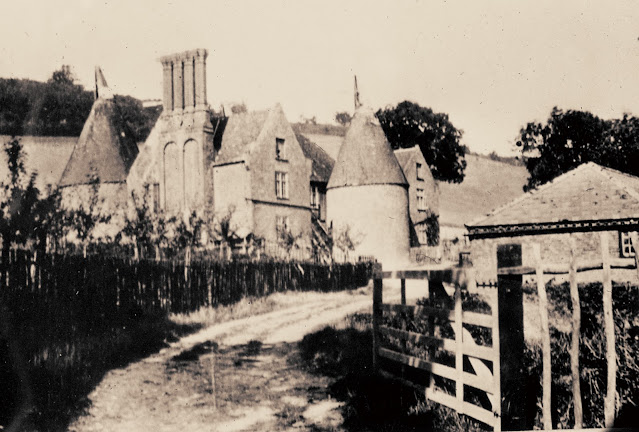
Court Farm, c.1900...

Old photographs show the outstanding feature of this "new" wing, a massive chimney stack topped with a set of four brick chimney shafts (Tinnoth House, at the other end of Pilgrims Road, has similar-looking chimneys, although this was a much later Lord Darnley build). Internally, this wing contained the remains of three fireplaces of moulded brick skimmed with mortar and ornamented, one having a typical Tudor four-centred arch.

Oddly, given its magnificence, this wing was eventually relegated to a store for farm equipment. The northern wing was probably not built at the same time, but appears to be a later copy of the southern wing. Early photos show the round type of oast in front of the building, these dating from 1839. 

View from above Court Farm, c.1920...

By 1966, the south wing had badly deteriorated and was in poor condition. The chimney shafts had already been partly demolished and the remainder of the stack was shored up. Two of the three round oasts had already been decapitated and were being used as stores.

The chimneys finally collapsed in 1973. In 1975, the Dutch Barn burned down. Further damage to outbuildings occurred during the Great Storm on 1987.

The present building has had much rebuilding, including restoration work after the chimney collapse in 1973.

View over Court Farm, c.1973: see c.1920 view above...

Court Farm, c.1973, same view as the c.1900 photograph above...

Court Farm, c.1973...

In 1840, title deeds show that a Mr. William Holding took over the tenancy of the farm. Around this time, between 1838-47, the property became known as Court Farm. 

Since 1871, Court Farm has been run by the Lingham family, who still farm the surrounding area today. Andrew Lingham also works closely with Plantlife, using his skills and unrivalled local knowledge to help maintain Ranscombe reserve over the hill in nearby Cuxton. Without the Linghams' involvement, I suspect the local countryside around Cuxton and Halling would look very different, and not for the better. 

Court Farm today...

The current farm shop opened in 2003, and has established a good reputation as a high-class butcher offering local and often farm-produced products. 

Update: On September 1st. 2021, the Cuxton Bakehouse moved their bakery operations to Court Farm, offering a local home delivery service (by bicycle!) for fresh-baked bread and cakes, with a small selection also available in the farm shop.

Tim Bedford, the Cuxton Bakehouse baker, at the door of his new premises on opening day...

Second Update: In April 2023 (after suitably cleaning up one of Andrew Linghams's old barns), the Moot microbrewery and tap room opened its doors to the thirsty of Upper Halling, who have had a 20 year wait to regain a local watering hole...

Team Moot (photo stolen from here...)

References:

Across the Low Meadow - A History of Halling in Kent, by Edward Gowers and Derek Church, 1979.

Thursday, 21 February 2019

The Grapes of Wealth...


Luddesdown from Wrenches Shaw, late evening - enjoy while you can?

Towards Cobham from Wrenches Shaw - late evening:  Enjoy while you can?

A while back, I found out that much of the farmland around Luddesdown had been put up for sale.  This area is one of the few remaining unspoiled areas of North Kent, offering spectacular views of the seasonal changes of a classic English North Downs agrarian landscape. 

Naturally enough, this has caused some unease in the local community. Very little of North Kent has managed to avoid the rapacity of greedy developers, and the merest thought of Luddesdowne vanishing under yet more high-density, low-cost/quality housing for London refugees is too horrible to contemplate.

So today, I set out to the Golden Lion in Luddesdown, to attend a public meeting with the new owners of Court Farm and Brookers Farm. These arable farms are archetypal English farmland and have remained pretty much unchanged in character for the last hundred years, and contribute so much to the beauty of the area.

To be honest, I had been half-expecting to have to listen to some stuffed suits explaining how the new overseas owners had added Luddesdown to their land investment portofolio and had no present plans to significantly change blah blah blah - other than putting up lots of barbed wire and making public access difficult a la Church Hill in Cuxton (as foreign owners of English land so often do...).

Instead, the “new owners”, Holly and Neil, turned out to be a very pleasant and very English young married couple. Holly (rather nervously) took the microphone to explain her background to the sixty or so people packing the Golden Lion bar, before outlining their ambitions to turn the area into an eco-friendly vineyard.

Holly is the eldest daughter of the entrepreneur Mark Dixon, the colourful Monaco-based English billionaire businessman best known as the founder of serviced office business Regus.

Mr Dixon himself is no stranger to the vineyard business, already owning the Chateau de Berne vineyard and spa complex in Provence and the Kingscote estate in Sussex, and has undoubtedly provided the financial backing for his daughter and son-in-law to develop Court and Brookers Farm, although not necessarily along the same lines.

In terms of local employment opportunities, they will certainly be created.  Whether anyone local has what's needed for starting and running a vineyard is debatable.  In conversation with their business manager (a forthright lady whose name I forgot to ask), it seems that the initial start-up crew (40-odd strong) will be itinerant in nature, and will be hired in and housed in a temporary camp site for the duration of the initial vine planting.

Quite what the effect of all this upon Luddesdown and its surrounding countryside remains to be seen. A vineyard and bottling plant (and, I suspect, the inevitable spa/hotel/conference centre) will undoubtedly increase the amount of traffic down the narrow country lanes around Luddesdown.  

And replacing the annual cereal crops with permanent vines will inevitably mean an end to the glorious and colourful ever-changing seasonal views across the valley. The green fields will no longer undulate gently in the valley breezes as they turn to gold in the summer. The spectacular wildflower vistas of blues, reds, yellows and whites that once flourished amongst the oats and barley will be lost in the monoculture of the vineyard.  Better than a sea of houses, though...

Sadly, the view itself from Wrenches Shaw may well be lost should the vines be strung up the hill from the east of Cutter Ridge Road.  Two metre-high vine canes would effectively fence off the view from Bassett’s Seat with a wall of vines. 

Holly and Neil seem like very likeable and I really wish them all the best. They genuinely seem as if they want to preserve the character of the area as far as they can. I just hope that they can find the time to walk the paths around their land, and in particular, to take in the view of their land from Ray and Eiley Bassett’s memorial bench up on Wrenches Shaw, before it all gets blanketed under vine poles.

And to reflect upon what they hold in their hands.

It would be a tragedy if that view were to be blotted out by the dull, dreary monoculure of vines.

But at the end of the day, change happens. We can all be thankful that as changes go, a new vineyard springing up on the landscape is not a disaster, just something different...