Thursday, 27 September 2018

Wrenches Shaw...

Following the footpath NS211 from Stonyfield Woods in Halling eventually leads you out into Luddedowne.

Location of Wrenches Shaw
The views from Wrenches Shaw across the valley are always worth taking in, although what the future will hold now that the land is under new ownership is uncertain.  There is a memorial bench just where the path leaves the woods.

Luddesdowne Church from Wrenches Shaw...

At this time of the year, some interesting fungi can be found in Wrenches Shaw...

Fly Agaric

Ringless Honey Mushroom...
Following the harvest, several types of wildflower can now be seen in the field edges by the woods...

Charlock...
Charlock (Wild Mustard) is often planted as a cover crop in winter.  I think the above is an example of Charlock, but it is apparently quite easily confused with other members of the same yellow-flowering cabbage relatives.  The seeds are poisonous - other species are used in mustard.  The leaves are apparently quite tasty, though - not sure I'd want to trust my own ID skills, however...

Borage...
Borage was traditionally cultivated for culinary and medicinal uses, although today commercial cultivation is mainly as an oil seed.  Borage is widely used in Europe used as either a fresh vegetable or a dried herb. As a fresh vegetable, it allegedly has a cucumber-like taste and can be used in salads or as a garnish.  I think I'll stick to cucumbers in salads, though...

Germander Speedwell...
This pretty little flower can be found pretty much all year round.  It can be distinguished from other speedwells by the double line of hairs which grow on either side of the main stem.

Scarlet Pimpernel...
The little red flowers of Scarlet Pimpernel were also in abundance.  The plants are poisonous, although as yet demands by morons to wipe them out have thankfully yet to be made...


Saturday, 18 August 2018

Dode Church...

Deciding on a whim to walk from Upper Halling to the Amazon and Tiger in Harvel, I chose to take a route that led me past Dode Church in darkest Luddesdown, which I had not seen since before it had been restored in the 1990s.

From Mays Wood to Harvel...
Nestling in Wrangling Lane, which runs along the bottom of the silent and secluded valley beneath Holly Hill, the little church at Dode was built over 900 years ago during the reign of William II of England (William Rufus, the son of the Conqueror) at some time between 1087 and 1100.  Archaeological evidence shows that the area was inhabited during the time of the Roman Empire, and probably before long that.  The church itself is built on a man-made mound that certainly predates it.

Dode (sometimes called "Dowde") Church...
Like many villages in the area at the time, the village of Dode was badly hit by the Black Death in 1349, with every single inhabitant either killed or fled.  Other than the church, no trace of what is sometimes referred to as “The Lost Village of Dode” remains visible anywhere today. 

The church was last used as a place of worship in 1387 and then deconsecrated on the orders of Thomas Trilleck, the Bishop of Rochester, but unlike its structurally-similar twin in Paddlesworth on the outskirts of Snodland (TQ6862 : St Benedict's Church), it was never reconsecrated.

 
With the village abandoned, the church remained unused for centuries. In 1901, it was purchased by an antiquarian, George M. Arnold, Mayor of Gravesend. He restored the walls and roof of the church and in 1954, the Arnold family returned the building to the Catholic Church. It was rededicated as the Church of Our Lady of the Meadows and for a while, mass was celebrated there at least once a year.

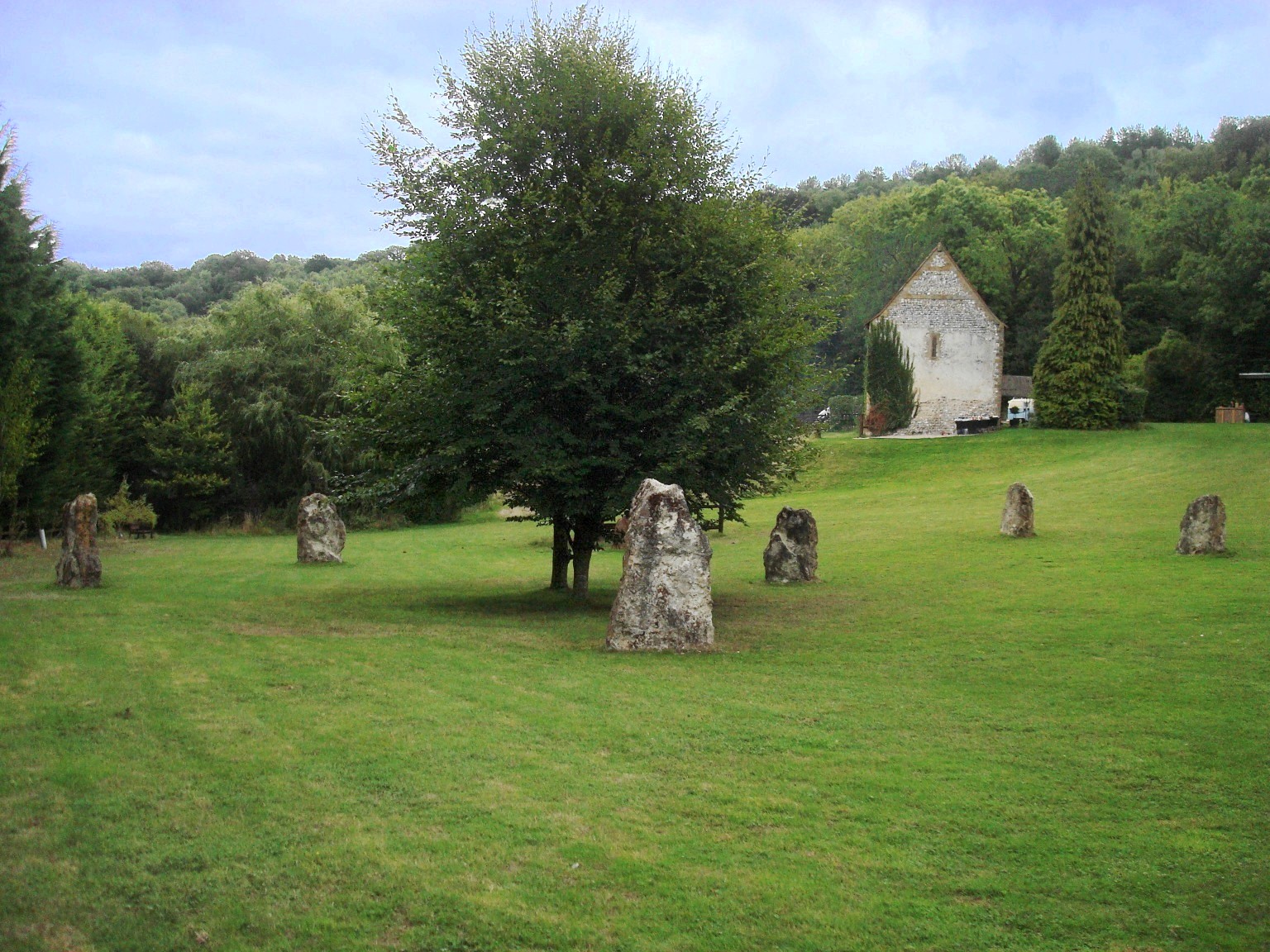
Faux standing stones (pretty certain they weren't there 40 years ago...)
The building fell into disuse again however, and was vandalised. In 1990, Doug Chapman, a chartered surveyor who had worked at Canterbury Cathedral, purchased the church and began restoring the building, originally with the intention of turning it into a weekend home. After a change of heart, it was restored as a church and licensed as a civil wedding venue.  Weddings are still regularly held there.


There are many stories linking Dode Church to ancient ley lines and ghostly goings-on, all of which are (in my opinion) just so much credulous mumbo-jumbo. That said, the place is undoubtedly "atmospheric", though whether this is down to the preternatural quiet of its surroundings or an awareness of its long and somewhat sombre history is difficult to say. 

I do not regard myself as particularly superstitious or spiritual, but I do find the place to have a powerful ambience, one that I can only describe as an air of wistful melancholia. I get the feeling that the building itself is sad and lonely and craves human company, that it is desperately seeking joy and happiness, the laughter of children and the communion of the elderly that other less tragic churches get to experience in their weekly existences. There is a sense that it longs to shake it off its neglected and plague-blighted past. Perhaps its current role as a wedding venue is just right for it in that respect.

Dode Church interior, still lit up just after a wedding...
One acquaintance of mine (now a very senior member of Her Majesty’s Constabulary and the most level-headed chap you could possibly meet) tells me that, as a junior police officer, he used to find that night patrols of the Dode area were often particularly eerie, with radio contact never working in the claustrophobic and stifling shadow of Holly Hill. None of his peers liked going near the place at night.

The wedding business seems to be doing well though, and the venue is seldom unused over the weekend.

Harvel C.C. v Leeds & Broomfield C.C...
On a different note, I was pleased to find that Harvel Cricket Club is still going strong, and was able to watch their game against Leeds & Broomfield from the pub garden for a couple of hours before setting off for home again.

Saturday, 11 August 2018

Upper Halling to Luddesdown...

My usual route, starting from May's Wood, through Wingate Wood, turning down through Bavins Shaw and up the other side of the valley...

Halling to Lower Luddesdown..

The track down between Stonyfield Wood and Bavins Shaw is a pleasant, open ride often frequented by fast-flying Silver-Washed Fritillaries and other butterflies during the summer.  Although the hot summer has brought the butterfly season to an early close, a few battered fritillaries could still be found...

Silver-Washed Fritillary (left) and Meadow Brown...
The dry conditions have kept the blackberries fairly small in most places, but the bottom of the valley has still retained some moisture and the blackberries are pretty good here...

Blackberries...
Along the wide farm track up the hill towards Halling Wood, various wild flowers are still putting on a good show...

Clustered Bellflower...
Yellow Chamomile...
Hoary Ragwort...

The views from Wrenches Shaw show that the harvest has been completed...

Luddesdown, looking west from Wrenches Shaw...
Cobham, looking north-west from Wrenches Shaw...

Friday, 27 July 2018

May's Wood to Luddesdown...

The usual route...

The drop down to the bottom of the valley at Bavins Shaw is a wide, pleasant farm track populated by many fast-flying butterflies...

From Stonyfield Wood to Bavins Shaw bottom...

Painted Lady...

Silver-Washed Fritillary (male)

At the bottom of the valley there was a clearing with an eye-watering stand of wild Parsley in full flower (the pollen made my eyes water - and I am not a hay-fever sufferer!)...

Wild Parsley...

The Rosebay Willowherb was also in flower, providing a spectacular colour contrast...

Rosebay Willowherb...

Following the wide track up through Bavins Shaw towards Halling Wood, many other plants were also in flower...

Clustered Bellflower....

Stemless Thistle...

Spear Thistle...

The marjoram is a butterfly magnet...

Brown Argus on Wild Marjoram...

The bone dry oat fields above Luddesdown are ripe for harvest...

Luddesdown from Wrenches Shaw...

Tuesday, 24 July 2018

Church Hill and Mays Wood...

A short walk up Church Hill and then back along in the shade under the northern edge of Mays Wood...

Church Hill, looking south...

The heat brought the meadow butterflies out in good numbers...

Gatekeeper (male, left) and Meadow Brown on Marjoram...
Gatekeepers on Ragwort...

Meadow Brown on Greater Knapweed...

Various wildflowers were in abundance...

Hemp Agrimony...

Nettle-Leaved Bellflower...

Teasel....

Friday, 13 July 2018

To Luddesdown from Wingate Wood...

It wasn't all just butterflies today, as there was much else worth taking in...

Despite the heat, Wingate Wood was still cool and green...

Wingate Wood...
At the bottom of valley at the south end of Bavins Shaw, a huge stand of Wild Parsnip was in full flower...

Wild Parsnip
Up the other side of the valley, many other flowers were in evidence...

Common Centaury...
Yellow Loosestrife
Wild Basil...
Burdock...
Coming out at Wrenches Shaw, some green still manages to persist in the fields despite the last six weeks of relentlessly hot and dry weather...

Luddesdown from Wrenches Shaw
Cobham from Wrenches Shaw
At the bottom of the field by Buckland Road, a profusion of Chamomile was in flower...

Stinking Chamomile...

Butterflies of Rochester Forest...

To the south of Halling Wood there is a track where, in most years, butterflies seem inordinately abundant in June and July.  These are some photographs of just some of the butterflies I saw on this particular day...

Ringlet
Ringlets were in abundance in the brighter rides and pathways, though few were inclined to stay still long enough for a photo opportunity...

Comma...
The distinctive white mark that gives the Comma butterfly its name can be seen on the underside shot below...

Comma underside...
At the foot of the hill, there is an outcrop of Common Ragwort, to which Brimstones seem particularly attracted to...

Brimstone...
Ragwort itself acts as a food plant for larvae of the Cinnabar moth, a distinctive orange and black hooped caterpillar which can often be found on it...

Cinnabar moth caterpillars...
The Speckled Wood butterfly is commonly found throughout these woods.  The males seem territorial and pairs can often be seen barrelling around each other, trying to keep sole rights to their patch...

Speckled Wood...
A Red Admiral was also seen, basking on the dry soil.  Note the small white spot within the red band of each forewing: this is a common aberration, bialbata...

Red Admiral...
There is one short stretch of farm track where the Silver-Washed Fritillaries are often particular numerous. On this day, I counted nine of these fast-flying orange beauties, many of whom were feeding on or flying around one particular Buddleia bush...

Silver-Washed Frittilary, male...
The males (distinguishable by the four black lines of pheromone-soaked scales on their fore-wings), live a high-octane lifestyle, flying powerfully up and down the sunny woodland tracks and seldom coming to rest.  This one was refuelling before zipping off to fight his rivals or hunt down the less-active females...

Silver-Washed Fritillaries on the wing...
In the shot above, three males can just be made out, each a blur as they chased each other up and down the woodland track.  The darker-coloured females lead a quieter life, and can often be glimpsed flying in a more stately fashion around undergrowth at the bases of trees, looking for a suitable spot to lay their eggs...

Female Silver-Washed Frittilary...
White Admiral...
A couple of White Admirals were also seen, with their distinctive gliding flight interspersed with powerful wing-beats bringing them down from the trees to patrol the woodland tracks or to occasionally rest on the forest floor, where I snapped this one...

Also seen were two Peacocks, a few Meadow Browns, many Large Whites, a few Small Whites and Green-Veined Whites and quite a few Gatekeepers...and, (just briefly, as he settled on the ground just in front of me) a single male Purple Emperor!

This was the first one I have ever seen around here, and I would dearly love to get a photo of this rarity, a species that usually lives up in the tree tops and only rarely comes down to sip from mud puddles or animal droppings.

14 butterfly species in 500 yards of woodland track isn't bad going by any means....