Wednesday, 26 January 2022

Vanished Halling - Portland Row...

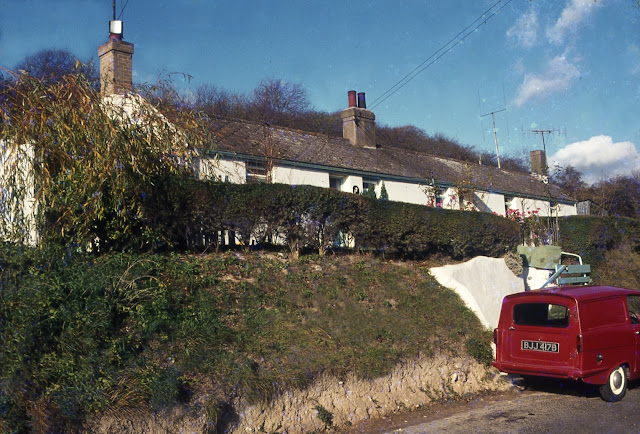
Warren House, North Halling, January 2022...

Along Pilgrims Road in North Halling lies Warren House. Whilst not a particularly attractive building, it seems that there has been a building on this site for a very long time. Warren House was once part of the Whornes Place estate and is shown on a 1670 survey map of the estate prepared for Sir John Marsham, the owner at the time (and which can be viewed on request in Medway Archives). The original Warren House may well have been built at the same time as Whorne's Place, sometime around the end of the 15th century.

It certainly pre-dates Portland Row, a now-demolished row of cement worker's cottages built to the east of Warren House around the time of the great expansion of the Medway valley cement industry in the mid-nineteenth century.

Portland Row, Pilgrims Road, looking east, c. 1910...

If you look around the edge of the bank by the road at Warren House, you can still see a course of the original red bricks that may have formed the foundations of the Whorne's Place estate building, The red clay bricks do seem to be of a similar type to those used in the fabric of Whorne's Place. It was clearly quite substantial, certainly larger than the granary building on the Rochester Road we call 'Whorne's Place' today. Very little seems to be known about Halling’s current Warren House itself. 

Brick foundations of the original Warren House?

The Kent Archaeological Society’s 2011 review, “Monumental Inscriptions of St Michael's Church, Cuxton”, tells us that the Halling burial register notes that a Mrs. Anne Siddall died in Warren House in 1825 and is buried in the graveyard at Cuxton Church. It seems unlikely that the Warren House mentioned there was the gamekeeper’s cottage on the Cuxton/Luddesdown border, giving its Halling listing.

The 1901 census mentions Warren House, as well as 1-11 Portland Row, Bank Cottages (a row of four tiny terraced cottages on the bank opposite Whorne's Place: only two are mentioned in the Halling census as the parish boundary passed through the middle of the terrace, the other two appearing on the Cuxton census!) and 1-4 Clinkham Cottages. The occupations of those listed as living there seem to be largely associated with the nearby Trechmann and Weekes cement company who worked the Bores Hole pit which lay between Church Hill and Pilgrims Road, with the factory itself being located behind Whorne’s Place on the Rochester Road.

Bores Hole pit, with the Trechmann and Weekes works in the background...

Some of the Portland Row residents are family names with strong links to the Cuxton and Halling area: William (“Boner”) Baker and his family are listed as living at No.1 Portland Row, William being referred to as a “horse driver”. 

William "Boner" Baker, resident of No.1 Portland Row...

Thomas Woolmer (“cement labourer”) and his family lived at No.8, with James Bonneywell and his family living at Warren House, along with Richard Rowe, a boarder and fellow cement labourer.

Portland Row was built in the 1850s, probably by Trechmann and Weekes. At the time, it was common practice for the local cement companies to provide housing and amenities for their workforce, the names of the houses, terraces and roads often reflecting the companies that built them. 

The 1869 OS map for the area shows Warren House and the newly-built Portland Row, calling the latter “Sebastopol” (presumably in commemoration of the siege of Sebastopol during the Crimean war in 1854-55) and also referring to it as “Iron Cottages”. 

Ordnance Survey map 1868 showing Portland Row (also called Sebastopol Terrace or Iron Cottages)

A later map of 1898 shows that an additional row of small cottages to the east of Portland Row had been built. I think these may be the “Clinkham Cottages” referred to in the 1901 census, given that there are four of them and their listing in the same area as Portland Row and Warren House. 

1898 OS Map, showing Portland Row (Sebastopol Terrace) and Clinkham Cottages to the north...

At that time, No.1 Clinkham Cottages was occupied by Mr. Reuben Wraight and his family, with No.3 being the residence of another Wraight family (another name with strong local connections) that of Mr. Thomas Wraight. Both Reuben and Thomas Wraight were listed as “railway engine drivers”, presumably working on the engines used in the cement quarries.

At the beginning of the twentieth century, Formby Brothers operated the Clinkham lime plant at Halling (the Formby works, which became Batchelors, and then latterly Rugby Portland) and mined the Clinkham Grey pit (now called, by some, Blue Lake or St. Andrews Lake). The cottages may have been built by Formby’s and were certainly named after the associated works.

Clinkham Cottages (latterly known as Portland Villas), 1972 (photo by Derek Church)...

An OS map from 1938-1945 shows the original eleven Portland Row cottages, but a photograph from around that time shows only eight cottages, suggesting that the eastern three cottages had been demolished at some point during or after the Second World War.  A number of bombs did fall on the banks above Halling and it seems that the cottages suffered damage as a result, as mentioned in Ron Underdown's Memories of Halling.

Portland Row, c.1950. The steps and the base of the gas lamp can still be seen in the bank.

It has been said that Warren House was part of Portland Row but as stated above, I believe it pre-dates it.  The photos show the west-facing aspects of both buildings, and it can be seen that the chimney structures are different.

Demolition of outbuilding at Warren House, 1974, showing old brick oven (photo by Derek Church)...

View of Warren House with Portland Row just visible behind the trees (photo by Derek Church, 1974)

Portland Row and Clinkham Cottages were occupied until at least the 1970’s, but (like so many other Cuxton and Halling buildings) had become difficult to maintain to modern standards. The OS Map of 1970 still showed them in existence but they were finally demolished in the mid-1970s.

Portland Row, 1972 (photo by Derek Church)..

Clinkham Cottages, looking west with Portland Row in the background, 1972 ( Derek Church)...

Warren House still remains and two modern bungalows were built on the site roughly between where Portland Row and North Halling Cottages were. Portland Row itself was never redeveloped and remains unoccupied as scrubby woodland.

Modern bungalows on the site of Portland Row/Clinkham Cottages...

This seems rather curious given the rapacity of developers and the fate of other old buildings in the area, such as the Paddock and Bridge House in Halling and the Old Post Office Row in Cuxton.


Sunday, 23 January 2022

Vanished Cuxton: Brickhouse Farm...

Brickhouse Farm, Bush Road, Cuxton, c.1920...

The picture above shows Brickhouse Farm it as it was in around 1920, with a front extension facing Bush Road (built in 1815) and an older original portion behind. The rear half was probably over 300 years old. In the background are hop kilns (that building has been wonderfully restored and is now the B&B) with Mill Hill in the distance.

Brickhouse Farm was another building in Cuxton that was purchased by Rochester Corporation after the Second World War. In accordance with standard council practice at the time with regards to buildings in Cuxton, it was left to become derelict before finally being knocked down (in 1951) and replaced with the existing house.

The site of Brickhouse Farm, c.1971...

Bill Marshall, who lived at Whorne’s Place, managed to salvage two inscribed bricks from the Brickhouse Farm building as it was being demolished. These bear the initials L.K.G.K. though I do not know what or who they stand for. 

Engraved brick recovered from Brickhouse Farm....

Mr. Marshall also recovered the inscribed stone from the frontage. The initials on the stone are those of William Pye (who was responsible for the extension) whose family had farmed in the area since 1808 and lived at Court Lodge. His son (also called William) latterly lived at Brickhouse Farm from 1878 until 1916.

Engraved frontage stone recovered from Brickhouse Farm...

The Pye family used to hold summer evening garden parties every year, to which the local villagers were invited.  Every day, Mr. Pye used to give the farm workers skimmed milk free of charge. When the milk was ready for collection, a white card was placed in the kitchen window and the local children used to run down and collect it. 

Reference: 

pp. 92, 100, Cuxton – A Kentish Village, by Derek Church (1976, ISBN 0 903253 12 7).

Monday, 17 January 2022

Big Yellow Taxi...


Many of the Medway councillors who sit on the Planning Committee (and who will be supposedly adjudicating upon the Vineyard Farms application to build an enormous restaurant complex on Green Belt land at Upper Bush) took the trouble today (15th. January) to come and take a look at what our not-so-local billionaire tax exile wants to concrete over.

Getting them here was itself a minor victory for the small group of local activists who have taken the trouble to battle their way through the smokescreen of glossy propaganda that forms the bulk of the Vineyard Farms application.

An unfortunately foggy Saturday morning for Medway's planning committee's visit...

The timing of the council’s visit did not do them any favours. Freezing cold fog in the middle of January hardly showed Bush Valley at its beautiful best, but nevertheless the councillors came along and squelched around in the fog and the mud on Barrow Hill, and hopefully got a feel for the peace and quiet of the place.

...if only they'd chosen the day before. The view from the bunker spot...

The date of the visit was well-known in advance and the protestors decided to put up a few placards along the route into Cuxton along Bush Road from the A228 and around Upper Bush for our visitors to maybe look at.  Needless to say, our brave councillors drove in from the Cobham end, although they did drive out along Bush Road so the posters weren’t a complete waste of time from that perspective. 

Some of the protest posters put up at Upper Bush....

Despite misgivings from the local Parish Council, a few people also arranged to park their cars up along Bush Road, just to show our visitors how tricky the road can be to negotiate when cars get parked up as they do at school run times.

As protests go, it was all pretty mild. Nobody was gluing themselves to anything and nobody was chanting silly slogans or shouting abuse (except for one demented, angry, mud-splattered Catweasel look-alike on a mountain bike who cycled past a small group of bemused residents at Upper Bush, shouting foul-mouthed oaths at them and spitting on parked cars as he went by).

Posters on Bush Road...

I walked through Upper Bush and down Bush Road that Saturday morning, and I didn’t think it looked as bad in terms of parked cars as it does on a typical school run time. Indeed, I’d say there was less selfish and inconsiderate parking than usual.

That evening, I’d thought I’d visit the Cuxton Village Facebook page, just to see how this little protest had been received. 

By and large, most people seemed pretty supportive.

There were a few inexplicably irascible people on there, however, who tried to give the impression that a thousand “Insulate Britain” protestors had descended on Cuxton village, gluing themselves to the road, manning barricades, throwing firebombs, blockading ambulances and fire-engines, bringing (non-existent) public transport to a grid-locked halt and causing mayhem, disruption and destruction on a massive scale. Some took to naming individuals who had left their cars in the road rather than parking on their own drives (heinous crime!) thus ensuring that they received lots of unpleasant personal on-line abuse from their perennially angry Facebook chums.

Posters on Bush Road...

Of course, none of them would have been saying anything about “selfish, inconsiderate protest parking” if they hadn’t known there was a bit of a “protest” going on in the first place. They wouldn’t have noticed anything unusual at all. The road was certainly no worse than at school run time, but that didn’t stop them using it as an excuse to sneer at and abuse those who are trying to stop Joni Mitchell’s dystopian ballad from coming true for Cuxton.

It seems to me that all of the anger about the winery actually lies with those who are in favour of it.  Most local people who object to it are upset by it and are determined to try and stop it, but they are not angry about it as such. 

Instead, its local proponents are the angry ones; angry, it seems, at anyone who disagrees with them. They are the ones coming out with the insults and the sneers, the accusations of NIMBYism and (oblivious of the irony) moaning that people are always moaning about something. When you try and engage them on the scheme’s drawbacks, they just (angrily) repeat what they seem to have read in the Vineyards Farms leaflet.

The protesters, by contrast, seem quite polite and tolerant of views other than their own and certainly aren’t going around throwing sneering insults at those who think that the winery is going to be the shiny, eco-friendly, local-job-creating glory that Vineyard Farms say it will be.

It made me realise just how effective the “divide and conquer” aspect of the Vineyard Farms propaganda has been. 

Our sunlit uplands: soon to be lost to paying customers of Vineyard Farms...

It seems that some local people don’t care about the wider implications of giving permission to build a development such as the winery on green belt land. The irreplaceable sacrifice of over a thousand acres of beautiful, peaceful green belt farmland to the profit-driven aims of a private company and the whims of its billionaire tax-exile boss are not that important to them.

It’s “good for jobs”, isn’t it? Maybe their fizzy wine will be cheap. And it’ll be somewhere nice to go and have a nice meal now and then, won't it? How dare a bunch of moaning NIMBY protesters try to stop that from happening?

You Don’t Know What You’ve Got ‘Til It’s Gone.

Big Yellow Taxi for Cuxton’s local winery supporters, please...

Friday, 14 January 2022

Kelly Tolhurst: A local history...

Fake picture, true sentiment?  Only Kelly knows...

Kelly Tolhurst, Strood and Rochester (and Cuxton and Halling’s) Tory MP is very much a local lady. Born in Gillingham and raised in Rochester, she went to school at old Chapter girl’s school before starting out her working career in marketing (for New Zealand Lamb) and then working for her own marine survey company.

Kelly first got involved in local politics after campaigning with residents to stop Borstal Recreation Ground from being lost to development, and between 2011 and 2018 she represented Rochester West as a member of Medway Council. In 2014, she stood as the Tory candidate in the by-election caused by the defection of Mark Reckless to UKIP.

To the area’s eternal shame, UKipper Mark “Rotter” Reckless won the 2014 by-election, but was thankfully dispatched off into political oblivion by Kelly in the subsequent 2015 general election, who secured a thumping 15,000 majority in the process. “He means nothing. He’s history. I’m the MP for the next five years”, she crowed after a bitter campaign conducted in the media spotlight, showing a ruthless streak one wouldn’t necessarily expect from her.

The oleaginous PM at the time, David Cameron, used newly-elected Kelly to bolster his shaky female-friendly credentialsthough her no-nonsense demeanor helped her avoid being pitched as one of “Cameron’s Cuties”. Nevertheless, her parliamentary voting record shows her unswerving loyalty towards her Tory leadership, seldom failing to vote for just whatever her Prime Minister of the day wants her to vote for.

"Oh, come on, Kelly. Just call me Dave..."

Given that she has this tendency to “go with the flow,” it is difficult to know what Kelly Tolhurst really believes in at any one time. She certainly seemed to tie herself in knots over the vexed question of Brexit. During her campaign against Mark Reckless, her views on the EU and immigration seemed to be more UKIP than UKIP, and yet in 2016 she took the pro-Cameron line, campaigning on the "Remain" side and saying:

“Having listened to the debate, looked at the facts, and spoken to prominent campaigners on both sides, I have now made my own decision that I will be voting to remain on the 23rd June. I believe that the risks to my country will be greater if we leave than if we remain part of the EU at this point in time.”

This surprised a few people from her anti-Reckless campaign days, earning her the sobriquet Turncoat Tolhurst” in some circles.

Following the Tory party post-referendum paroxysms, Kelly soon reverse-ferreted again and became a born-again Brexiter, writing to her few constituents who didn’t believe in national economic suicide, telling them that they were just “members of the London metropolitan elite” (a lazy insult straight from the desk of Dominic Cummings).

Such somersaults of conviction have done little to damage her popularity with her constituents. In 2017’s general election, she was returned with a majority of 9850, 54% of the vote, following that up with a massive 17072 majority and 60% of the vote in 2019.

Her constituents like her.

Cartoon by Gerald Scarfe...
Kelly seemed to get the itch to further her career after getting re-elected for a third time. She was already well-known for her debates with fellow MPs on matters of national importance, and fortunately for Kelly, loyalty is the one key factor when it comes to building a Tory ministerial career. As a result, she was finally rewarded with a position in January 2018 as Assistant Whip (HM Treasury).

Unfortunately for her, one of her first tasks back then was to be packed off to give a TV interview on BBC Newsnight. It was rather nasty of Euan Davis to ask her a question to which it was impossible to give an honest answer (“Apart from Brexit, what are you going to do?”) and Kelly fell at the first hurdle. Of course, the Tories had nothing to offer the country at time other than slogans (and still haven’t) and Kelly might as well have been sent into the studio in her underwear for all the support she had on that one.

The resultant car-crash of an interview, both for the government and Kelly herself, seemed to taint her subsequent career. She was shuffled around Westminster in a series of Parliamentary Under-secretarial roles, none lasting more than about six months, until she formally resigned from her last position in January 2021, citing “devastating family news” as the reason.

Unlike some of her local MP colleagues, Kelly is an intensely private person, refusing to live her life on FaceTube or whatever, and using social media strictly for business only.  She has never publicly explained what her “news” was, but Kelly has yet to return to the deranged, febrile merry-go-round of Tory ministerial politics. And I think she is well out of it at the moment.

The "official" Kelly...
Whatever you may think of her political leanings, there can be no doubt that Kelly Tolhurst is an immensely hard-working local MP. Her Facebook pages show her attending meetings and photo-shoots and generally doing her best to represent what she believes to be the best interests of her constituents. 

But take a look at her voting record. It’s grim reading for anyone who thinks we need to reduce the gap between rich and poor, or take positive action on climate change and the environment.

And there is one vote that stands out…

At the behest of her Prime Minister she voted not to support sanctions against MP Owen Paterson, who had been found by the Parliamentary Standards Committee to be taking money from healthcare company Randox and then apparently promoting their interests. The PM then did one of his trademark U-turns in response to the tidal wave of public outrage, making Tory MPs like our Kelly look craven and foolish in the process.

Kelly then showed just how out-of-touch she now is with the mood of her constituents, by saying that she actually believed that Paterson was somehow unfairly treated! “A standards committee is actually not a particularly pleasant process for anyone to go through… we needed to look at it,” she opined.

Er, no, Kelly, it’s simple. If MPs don’t break lobbying rules, then they won’t have to go up before those oh-so-beastly people at the Standards Committee, will they?

All of which brings me to Kelly’s stated support for the Vineyard Farms to build on Green Belt land at Upper Bush.

In common with a lot of people in Cuxton, I wrote asking her to support the Parish Council’s opposition to the winery project.  She wrote back saying “no can do…”

“I can confirm that, on balance, I am in favour of this application due the jobs it will create both on site and in the supply chain, the financial benefits to the community and wider area, and it could help to secure the surrounding land use as agricultural rather than leaving open to housing developers….”

“However, I do note that local people are concerned about the traffic impact which the winery could have on local roads and traffic. I know that traffic is an issue throughout the area, especially at peak times. However, the winery has provided information on their proposal to keep this as minimal possible.  I hope this has helped to confirm my position on this.”

But (rather like Brexit) nothing about Kelly's views is as clear-cut as it seems...

Only a few days after I received her letter, there was Our Kelly on her Facebook page, buffing up her environmental credentials in support of some RSPB initiative to help endangered birds.

Kelly going "green" on Facebook...

Someone had the temerity to point out that her sudden “keen for green” stance was at odds for her apparent support for the winery. 

Kelly’s response was indignant… 

As several people subsequently pointed out, that’s clearly at odds with her written responses to her constituent’s concerns about the winery. There are only two possible explanations for this:

1)      She has adopted her Prime Minister’s standard approach to being caught out, or:

2)      She has changed her mind.

Kelly and Boris. Discussing Peppa Pig World, perhaps...?

After all, this is the same Kelly Tolhurst who recently spoke and presented a petition in the House of Commons against the development of the former Deangate Golf Club on the Hoo Peninsula.

But why would she publicly support the residents of Hoo in their bid to prevent loss of their green spaces, but not the residents of Cuxton? 

Clearly, quite a few people had been getting in touch with Kelly to express their concern about the winery development.  Never one to stand firm in the face of public opinion, she subsequently sent out a letter "clarifying" her position.

Kelly's various public pronouncements on the winery can therefore be summarised as follows... 

“I’m in favour of this application, except that I am not supporting any tax exile to build a restaurant and wine bar complex at all. But I did say that I am in favour of it in principle, although I have never confirmed that I outright support the application.”

There, that makes it all clear now, doesn't it?  

In truth, I believe that Kelly is a bit conflicted with respect to the winery development. I think she personally believes in the preservation of green belt land in general, but knows that both local and central governmental dogma dictates that Cuxton and the ANOB that is Bush Valley are to be sacrificed to a "greater glory".   

I guess there are a couple of factors at work here.

First and foremost, at December's Planning Committee meeting it became immediately obvious that Medway Council's Planning department are 100% behind Vineyard Farms and are actively working with them to ensure that the billionaire tax exile behind them, Mark Dixon (boss of international office company IWG and weekend hobby farmer-cum-land speculator) gets his own way.  

Central to this is a decision to ignore NPPF guidelines that preclude developments of this scale and nature in green belt land. Instead, Medway Council have given Vineyard Farms the green light for the project, allowing them to hide behind the disingenuous excuse that a £30m restaurant, wine bar, visitors centre (with a wine factory almost incidentally tucked away in the basement) is an "agricultural building", like, say a barn or a cow shed. 

This is such an outrageous decision that I can't help wondering if Medway Council's planners would not have made it unless they were confident that central government (in the shape of arch-Brexiter Michael Gove, Secretary of State and final arbiter on major planning decisions) was fully on-board in the first place. 

Senior Medway council officials want their swanky city status back. Gove and his Brexity chums desperately want an investment project to trumpet as a success for their disastrous Brexit 

Cuxton and its green belt land doesn't stand a chance in the face of such dogma. It's all about saving political face rather than about local or national environmental considerations.  

There is simply no way that Our Kelly would want to get involved in any of that.

A second factor is around Kelly’s undoubted love for the River Medway and her connections to its associated businesses.

It is worth noting that Kelly is still patron of the MBSA (Medway Boating and Sailing Association) of which her dad, Morris (who owned Beacon Boatyard at Manor Lane in Borstal, and who sadly passed away in July this year) was treasurer. Kelly herself is a keen yachtswoman, something she spent a lot of her childhood doing with her dad on the Medway.  

Amongst the many distractions being belched forth by the Vineyard Farms PR smoke machine is the proposal for “river taxis” to bring vineyard tourists to Cuxton.

Clearly, this scheme will have no impact whatsoever upon the traffic situation in Bush Road: even the small fraction of the projected 70,000 tourists a year arriving by river taxi will still have to be funnelled across the insanely busy A228 and down little Bush Road, past people’s houses, the shops and the school, weaving in and out of the school-run Mums, the tourist’s Audis and BMWs, the parked-up visitor’s cars that couldn’t squeeze into the undersized winery car park, and the vineyard HGV traffic. 

Nevertheless, some of the winery supporters are hugely supportive of the "river taxi" idea. Indeed, one of them (a Mr. D.P. Taylor, apparently of Cuxton Marina) appears to have met with Dave Harris, the Chief Planning Officer, and some redacted people, and in an e-mail (subsequently posted as a letter of support for the winery on the Council Planning portal for the winery) suggested:

“The main obstacle along Bush Road seems to be on-road parking because some of the houses/flats do not have their own facilities for parking. One solution would be to request that The Kentish Wine Vaults purchase suitable house/houses when they become available along Bush Road and demolish the houses to provide off-road parking. (my emphasis) This solution would not only solve the existing traffic congestion but would adequately provide for the new traffic movements created by The Wine Vault project…”

(The e-mail itself was very revealing, and hinted at many meetings between the Council, local business people and various people whose names were blanked out - Vineyard Farm reps, or maybe even an MP or two?) that seem to have been going on behind the scenes. Needless to say, Parish Council representatives of Cuxton’s residents have been granted no such access to these folk…)

Whether Kelly supports the initiative to demolish Cuxton resident’s houses in support of the Vineyard Farms plans is unclear, but I think she would be in favour of anything related to use of the river, no matter how inconsequential to Cuxton's problems that may be. Maybe Vineyard Farms have sold that idea to her.

Kelly Tolhurst is not deaf to environmental concerns. As shown above, she acted on behalf of Hoo residents to try and help save their green spaces. She cares about the little birdies at Chattenden.

Yet at the moment, she hasn't publicly supported Cuxton Parish Council in its struggles against Medway Council, where a company (with the backing of a billionaire tax exile) are planning to finish ruining one of Medway's last areas of Green Belt land and an Area Of Outstanding Natural Beauty by slapping a massive concrete bunker on it, all with the Council's blessing.

For the life of me I can't understand why. Kelly hasn't explained her thinking consistently clearly and publicly, hence my speculation above.

As shown above, Kelly is not averse to changing her mind. That's a good thing. It shows she has one to change. 

So perhaps if enough people write to her, they can get her to speak out publicly about the Vineyards Farms plans for Upper Bush.  Her e-mail address is kelly.tolhurst.mp@parliament.uk.

You might want to tell her that building concrete bunkers with luxury restaurants and cafes on top isn't a good precedent to set for Green Belt land. Maybe you might want to mention that funnelling 70,000 tourists a year, plus all of the maintenance, construction traffic, plus thousands of chalk spoil waste lorries down Cuxton's narrow residential main road isn't a good thing for her constituent's quality of life.

You might also want to ask Kelly why she is happy to openly support Hoo residents in their fight against development of their green spaces, but not Cuxton's.

One of the few times Kelly Tolhurst has ever voted against her own party line was in opposition to privatised water companies being allowed to dump raw sewage into our rivers and seas.  

Yet she seems happy, by simple inaction, to let Vineyard Farms dump their massive turd on Upper Bush... 


Wednesday, 5 January 2022

Vogons, Cuxton, and the Dying Art of Protest...

The BBC's Vogon...

Anyone over the age of fifty may remember the 1970’s BBC Radio Series, “The Hitch-Hiker’s Guide To The Galaxy”, written by Douglas Adams. It was subsequently transferred to a novel and a BBC TV series (the latter notable for its truly awful special effects, which were often as funny as the dialogue).

In the series, Planet Earth was destroyed to make way for a “galactic hyperspace route” by a race of galactic bureaucrats called the Vogons. Vogons weren’t actually evil, just completely unthinking and stubbornly single-minded. They had an interesting attitude to things of natural beauty…

“(The evolutionary forces of the Vogon’s home planet) brought forth scintillating jewelled scuttling crabs, which the Vogons ate, smashing their shells with iron mallets; tall aspiring trees of breathtaking slenderness and colour, which the Vogons cut down and burnt the crab meat with; elegant, gazelle-like creatures with silken coats and dewy eyes, which the Vogons would catch and sit on. They were no use as transport because their backs would instantly snap, but the Vogons sat on them anyway…”

Vineyard Farms seem to me to be a little like the Vogons: both plan to destroy local people’s quality of life to build something that isn’t really necessary, and both have a disregard for things of peace and beauty (just look at the deep-ploughed desolation of the local valleys now, the ugliness of the wires and stakes, the air of weed-strewn neglect and the trashed hedgerows around Luddesdown).

Unsurprisingly the precious little vines, planted in such a hurry and over such a huge area, aren't doing too well. Harvesting in 2022 was the original boast: that now appears highly unlikely and is being quietly forgotten, it seems. Indeed, 2024 is being bandied about as a date for full production instead.  Catch 22?  

The Vogon guard in the story had quite a good slogan as well: “Resistance Is Useless!!” it bellowed. 

Maybe VF should adopt that as their public relations policy.

Municipal councils have a long history of treating little Cuxton with contempt, unfortunately. In the sixties, the village lost many fine old historic buildings that could and should have been preserved (such as the cottages in Upper Bush, Old Post Office Row and the Rectory).

Just afterwards, a local historian wrote...

"I cannot begin to imagine what goes through the minds of councillors who can destroy such a place of beauty...": Derek Church, Cuxton - A Kentish Village, 1976.

We are still trying to imagine that today, it seems.  Even worse was to come. 

"We Have To Trash Your Countryside 'Cos We Need The Jobs, Right...?" Sounds familiar...

In the mid-1980s, the Blue Circle cement company hatched a scheme to quarry the chalk in Dean Valley. Cuxton village was horrified. Surely that beautiful valley couldn’t just simply be destroyed on the whim of a rich company like Blue Circle?

Public meetings were held. Protests were made.

"Keep Dean Green" protestors...

"Keep Dean Green" protest against Blue Circle's Dean Valley chalk extraction plans...

None of it made the slightest difference. Blue Circle trashed the western end of Dean Valley anyway...

Chalk extraction, Dean Valley 1989...

Chalk extraction, Dean Valley, 1989...

Many factors stepped in to stop the damage to Dean Valley being terminal. Following the energy crisis of the seventies, the eighties saw great consolidation in the cement industry as overseas products began to compete. Many quarries simply ran out of raw material as land became increasingly scarce, and the industry contracted.

Local historian Derek's Church's impression of what Dean Valley would have looked like had chalk extraction continued..

Dean Valley itself did not furnish the quality or quantity of chalk required and activities ceased inside a year or so. The Halling (Rugby) works subsequently closed in 2000, with operations completely ceasing in 2009 and the site demolished in 2010.

The top-soil in Dean Valley was put back and now it is pretty hard to imagine the western end of the valley as it was briefly in the late eighties/early nineties. The pond, which marks the tunnel entrance though the hill to take the chalk to the Halling works, is the only feature left reminding us of those days.

The western end of Dean Valley today...

For Dean Valley, time and economics achieved what protests could not. It would be nice to think that justice would be served on Vineyard Farms in such a fashion, should their schemes come to fruition. Climate change, consumer fashion, economics and even central government policy on land use. VF are at the mercy of all of them. Who knows what the future will bring?

Dean Farm today: Vineyard Farms attempts to buy this have so far been rebuffed - for now...

These days, the banner-waving and slogan-shouting type of protesting is just as ineffective as it was in the eighties, is socially unacceptable (thanks to the antics of idiots like Insulate Britain) and is so much harder to actually do. Covid has restricted gatherings of people and new Tory legislation (the soon-to-be-approved Police, Crimes and Sentencing Bill) makes protesting virtually illegal anyway. A protest along the lines of the Dean Valley one could soon see you jailed for up to 51 weeks!

And people are too busy and have too many distractions these days, anyway. Many people struggle to even eat and heat, let alone worry about their local environment.  Which is right where our rulers want us serfs to be, I suspect...

The principle that green belt land should not be built upon and the damage the project will inflict upon the quality of life in poor little Cuxton doesn’t feature  anywhere. 

Anyone who objects to Vineyard Farms’ schemes is painted as a NIMBY, a tree hugger or a “fluffy hand-wringer”, even by some people who live in Cuxton, such has been the effectiveness of VF’s propaganda. “Divide and conquer” indeed.

Vineyard Farms have a monopoly on Medway Council's time - certainly our Parish Council have had no opportunity to present Cuxton's case to the Council Planning committee in the same way that Vineyard Farms can present theirs. The Council Planning department has simply ignored the arguments laid out in the 200+ objections they have received against the scheme.

The Vineyard Farms PR machine has a good grip on things and they have pretty much ensured that their agenda is the only one being heard.  “Look at our wonderful design, and how beautifully it fits into the green belt around it” goes the story. The local media certainly parrots that view, and most people outside of Cuxton (especially Medway's Planning department) seem to welcome the idea of the winery.  

The Planning Committee meeting of December 8th (and the video thereof) showed that bias quite clearly. Just watch it. It is rather shocking in terms of its one-sidedness. 

Explanations about the "exceptional circumstances" and "public interest" that would satisfy national planning guidelines for allowing development within green belt areas were scarce. Councillor Matt Fearn was given only five minutes to present this counterpoint on our behalf, to Dave Harris's thirty minutes of pro-winery cheerleading.

Both our own Parish Council and Kent ANOB have explained, clearly, concisely and unequivocally, why the winery should not be built. Those documents were mysteriously omitted from the Supplementary Notes given to the planning committee members prior to the planning meeting.

Watch this space...

Friday, 24 December 2021

A White Christmas...?

It is difficult to really imagine the size of the Vineyard Farms planned new restaurant and visitor’s centre for Green Belt land in Upper Bush. The glossy brochures that have so impressed our local Council planning department and that show the hordes of smiling, happy, hippy visitors lounging around, with Mark Dixon’s Tracey Island in the background, don’t really give an indication of scale.

But this thing is big.

Really big.

To give you an indication of just how big Lord Foster’s Flying saucer is, I’ve taken the architect’s drawing of the above ground restaurant, visitor’s centre and ornamental lake (and remember, Vineyard Farms are calling all of this an “agricultural building” to get it exempted from the prohibition of new builds in Green Belt land) and superimposed, to scale, a full-sized football pitch next to it.

The Vineyard Farms complex, compared to the size of a standard football pitch...

You can see that what is above ground is much larger than a standard football pitch. (Just an agricultural building, remember?  Honest guv'nor.  Just a £30m agricultural building, just like wot you get on any farm, right?).

What you don’t see is the majority of the building that is underground. Under the lake is an 85m x 60m chamber for their actual wine making area, excavated into the hillside to a depth of 12 metres. From the eastern side of the restaurant block, the building radiates out underground for another 30 metres, to a depth of around 6-7 metres for the fermentation tanks and barrel room.

Barrow Hill is going to be essentially hollowed out to create Vineyard’s Farms’ underground lair.

And all that adds up to a simply enormous volume of chalk that needs to dug out for this grandiose scheme.

Simple arithmetic (and a bulking factor of 1.4 for chalk) shows that volume to be in the region of 160,000 cubic meters

This is a very conservative estimate, and does not include any of the likely required foundation works, or anything else they might be digging up as part of the project. It’s just the estimated volume of the chalk spoil that will have to be dug out for the underground caverns, based on the dimensions given in the architectural drawings.

In Section 5.1.5 of their Construction and Environmental Management Plan (CEMP) they admit that "the total material that will be moved is estimated to be more than 100,000 tonnes" but they somehow contend (in Section 3 of the CEMP) that:

"Finished site levels have been determined to negate the need to remove any spoil from site. During construction, should any excavation spoil be unearthed that cannot be re-used this will be removed from site and disposed of at a suitable licensed waste transfer facility..."

Unless they are planning to just pile up the chalk in ugly, white swathes everywhere in Bush Valley (which would actually fit in with the devastated, torn-up valley they have already ploughed up for their vines), this claim doesn’t seem to stand up.

The excavated chalk would cover a standard football field to a depth of 32 metres (100 feet).

Spread to a depth of 1 metre, it would cover 40 acres, or 12% of the whole of Bush Valley.

The top soil cover is pretty thin, and even if they kept all of the top soil from the above ground restaurant area and the car park, they will only have about 10,000 cubic meters to play with. That will only cover about 50,000 square metres of spread-out chalk spoil to a soil depth of around 8 inches  - about a third of the chalk dug out, even if it was spread as thickly as one metre around the valley.

It is clear that they will have to lift the top soil off of a huge area of Bush Valley just to bury their spoil.  The mess, the disturbance, noise, air-borne dust and sheer ugliness this will cause for a few years is entirely predictable. Poor old Cuxton, and particularly Upper Bush, have been through it all before. It will be on a similar scale to the way Dean Farm valley was despoiled forty years ago...

Dean Valley, top soil removal in the early 1980's - soon to be repeated in Bush Valley?

As above...

It's just not practical to import more top soil or export a lot of chalk off site. They’ll need another 20,000 cubic metres of top soil (or around 700 lorry loads!) imported to site to cover their chalk spoil even if they do spread it pretty thickly. That’s a lot of extra traffic that’s not included in any traffic plan. You can multiply that by five if they have to take the excess chalk off site.

Vineyard Farms have so far managed to bamboozle Medway Council planning department, but fortunately some of the other councillors on the Planning committee are becoming wary of the smoke and mirrors approach of Vineyards Farms in trying to hide the more inconvenient, vague or impractical aspects of their grandiose aspirations.

Vineyard Farms need to be pushed on a lot more detail on how they plan to manage their excavation (as well as a lot of other things). But will anyone get an opportunity to do so?

If they get their way, Bush Valley could be afflicted with a White Christmas – for ever!  

Friday, 17 December 2021

Vineyard Farms: Raising A Stink...?


One of the many interesting things I learned from last week’s Medway Council Planning meeting (which deferred a decision upon the Vineyard Farms plans for a luxury country club and restaurant complex on Green Belt land at Upper Bush) was the existence of a proposed “energy centre” as part of the development. Councillor Gary Etheridge mentioned that this would produce 46% of the power requirements of the Vineyard Farms new Xanadu (and asked where the other 54% was coming from…).

One of the many criteria a developer needs to meet in order to justify the rape of green belt land is to demonstrate that their proposals are “low carbon” (whatever that really means) and energy-efficient. Vineyard Farms intend to tick this big green box with their “energy centre”.

Very little detail on how this will work has been provided by them, perhaps on the basis that no-one can object to it if they don’t know anything about it. I had seen references to the production of energy from biogas as the preferred “green energy” source in the Vineyard Farms glossy brochures on the Medway Planning Portal, but I had not paid much attention to any of it as there was so little detail.

In short, it seems that the grape pomice (the stuff left over once all the juice has been squeezed out of the grapes) will be put into an anaerobic digester to make methane, which would then be burnt in a gas-fired generator set to produce power. Although Vineyard Farms haven’t said so, the system in their brochure looks very much like the containerised system provided by Qube Renewables, a 2018 UK biogas start-up that has just sold out to a Singapore-based company (part of the ongoing national asset-stripping process that sees any potentially worthwhile UK company bought up by overseas firms: “taking back control” I think it’s called…).

The Qube bio-energy set-up...

The Qube set-up looks somewhat experimental, comprising of a bunch of shipping containers, flexible hoses and tanks that don’t look very pretty at all and which will presumably be hidden away inside the “energy centre”. There isn’t a lot on-line about Qube Renewables beyond what’s on their web-site and it would be interesting to know if they actually have any working units in the UK.

In terms of the energy claims, the “46%” figure did actually add up when I did some back-of-a-beer-mat calculations. If you assume that the vineyard will be 900 acres and yields 3 tonnes of grapes per acre (typical low-end UK yields according to Mr. Internet), that’s 2700 tonnes of grapes. Pressing takes out 80% of the mass as the juice, the other 20% being pomice, so there will be 540 tonnes of that to feed to the little bugs in the bioreactor. It seems (according to Mr. Internet again) that you get around 150 cubic metres of biogas from a tonne of waste, and a cubic metre of biogas put into a gas-fired generator yields about 2KWh of energy. So if all goes well, the bio-digester should produce 150 x 540 x 2 = 162,000 KWh a year, a figure pretty close to the one Vineyard Farms quote in their glossies (158,000 KWh).

If all goes well…

Even when all is running smoothly, anaerobic digesters produce low levels of hydrogen sulphide, the rotten eggs smell. This has to be removed from the biogas as it is acidic and corrodes the gas combustor. Nevertheless, anaerobic digestion facilities tend to have a permanent whiff about them, something the Riggalls Court residents (and maybe the rest of Cuxton) might just get to find out for themselves.

The bugs in anaerobic digesters are delicate little things that need constant TLC. Feed them something they don’t like, or get the temperature wrong, and they die off. Sometimes the bugs just decide to die out of spite anyway. Anaerobic digestion can be a finicky technology. I used to work for a large company that had a biodigestion plant to treat its organic wastes, and it was forever stinking the place out (and the neighbouring town a mile or so away). When anaerobic digesters go wrong, they can also generate mercaptans, the smelliest substances known to man (methyl mercaptan has an odour threshold of one part per BILLION).

And indeed, nearly everywhere you find large anaerobic digestion plants, you’ll find complaints about the smell.

Of course, the Vineyard Farms operation is quite a small one in terms of bioreactors, so the amount of pungent gas should be relatively small. Their digester will also benefit from having a consistent quality of feedstock (unlike food waste-based plants) which should help to keep the bugs happy. Nevertheless, the energy centre is quite close to a residual area. Any problems with it and Cuxton will soon smell them. 

And so will the customers of Vineyards Farms restaurant and café. You can be pretty sure that in the event of the slightest pong, VF will pull the plug on their biogas plant, meaning that the whole operation won’t really be very “green” at all in energy terms. (Only a cynic would suggest that’s why the vent stack from the energy centre is on the eastern side of the winery, so that any smell would be carried away from it by the prevailing south-westerly wind and blown over Cuxton instead…)

The Air Quality plan says nothing about smells or hydrogen sulphide levels. Perhaps it should.

The Qube Renewables stuff still has a whiff (no pun intended) of the unproven about it. Perhaps Vineyard Farms need to show Medway Council (and Cuxton residents) that this technology is a reliable long-term option with no stinky down-sides.

There are other unanswered questions as well. Where are Vineyard Farms going to store 500 tonnes of pomice? They say they are going to put the stuff in “vacuum bags” for storage. I can’t see this stopping it from decomposing, another possible source of odour when the bags are opened. In reality, I think the pomice will have to be properly dried for storage (off-site? More vehicle movements?) which itself would be energy intensive. Perhaps we need to know more about the pomice storage plans.

Personally, I  think the Vineyard Farms “energy centre” is just another smoke-screen, along the lines of the “there’s-no-traffic-in-Bush-Road” smoke-screen and the “local jobs” smoke-screen and the “our-luxury-£30m-country-club-is-really-just-an-agricultural-building” smokescreen. Maybe the bio-reactor will work, maybe it won’t, but either way they’ll get the “green” box tick they need and if they bin it a year or so into operation, who’s to penalise them? They’ll have what they want by then.

I think they should be made to have a Plan B. Vineyard Farms were quick to write off wind and solar power generation as they allegedly didn’t want to spoil the ANOB, but their country club will do that anyway. So why not put a few wind turbines and solar panels (and a bit of battery storage) at the southern end of Bush Valley, an area which is already disfigured by rows of pylons? 

The pylon run at the southern end of Bush Valley: room for a few wind turbines?

They could easily run the wires underground down to their club-house. Nobody would complain, I think, (not even me!) and it would be a much less risky and less smelly bet than anaerobic digestion as a means of providing green power. And if the biogas option really does turn out to be able to generate 46% of the building’s power needs, why not go for the other 54% anyway, like Councillor Gary Etheridge suggested?

Or is cost the real worry?  Is the “energy centre” really just the cheapest option for a disposable asset, to be quietly dropped when the “tick in the green box” is achieved?

We’ve lost our chance to raise an objection to Vineyards Farms energy plans, but maybe we can still write to our Medway councillors now that they awaiting “more information” from them prior to another planning meeting.

Perhaps we could say that we are concerned about the proximity of the Vineyard Farms energy centre’s anaerobic digestion plant to Cuxton village, and could ask them to ask Vineyard Farms:

·         Are their any other biogas generation units similar to their planned one in current operation in the UK?

·         If so, are there any issues with odour or reliability?

·         Where are Vineyard Farms planning to store their annual 500 tonnes of grape pomice prior to use in the bioreactor?

·         How will the pomice be treated to prevent decomposition during storage?

·         Will an odour or hydrogen sulphide condition be added to the local Air Quality Plan?

·         What are Vineyard Farms’s alternative plans for renewable energy in the event that their biogas plant proves unviable?

Or we could just let Vineyard Farms get away with being unchallenged on this. It could be a bit more than just a rat that we are smelling here…