Thursday, 2 June 2022

Views around the Vineyard (1)...

I hadn't been out to Luddesdown much until quite recently, where tales of industrial activity drew me out to see what was happening at Court and Brookers Farm.  I started this walk from where the Wealdway track crosses the road near Buckland Farm at the bottom of Lockyer's Hill, just down Wrangling Lane...

Vineyard Farms (VF) seem increasingly touchy about "trespass", so I am told. I hope they aren't getting all hostile and prickly, just because Cuxton's local residents managed to persuade Medway Council's planning committee to reject their grandiose plans for a massive factory and country club on the green belt AONB that is Upper Bush. 

That would be a shame, especially as they will probably get what they want anyway as a result of a public inquiry. VF are, of course, perfectly within their rights to keep people away from their land if they so wish, except for the public footpaths (which they can only close off for up to 28 days in any year). 

Walkers like myself had become used to the unrestricted access we had to the woodlands and farm tracks when the land was owned by Cemex. Its new owners now call it all the "Silverhand Estate" and things are very different now. Even the icy tone of the name gives a hint of the company's seemingly chilly attitude towards its neighbours.

However, it has to be said that Vineyard Farms have certainly lived up to their promises of creating local jobs. Indeed, it seems that they have now even employed people whose job description requires them to roar around the network of local farm tracks in Land Rovers and pick-up trucks, to no apparent purpose other than to see how fast they can go and how much dust they can raise in the process.  

They are certainly working at a level "above expectations" from what I can see, albeit from a safe distance.

Meadows off the Wealdway, Buckland...

I have no problem with sticking to the public footpaths, and would advise anyone venturing onto the "Silverhand Estate" to do the same. Landowners (or their representatives) are allowed to use "reasonable force" against trespassers, so be careful not to give them an excuse to throw their weight about. Taking notes or a video of any such "meeting" may be a good idea, just as evidence, if things turn nasty.

Unlike others of my acquaintance, I have yet to have any personal confrontations with members of the VF 4x4 squad but then as I said, I usually stick to the available public footpaths (I'm too old and creaky to climb over gates these days anyway). I even kind of support the (polite) enforcement of that policy - not so much out of respect for Vineyard Farms' land ownership, but because it looks like the skylarks are returning to the valley and I'd hate a dogwalker's stupid off-the-leash dog or a blundering part-time rambler to disturb the skylark's nests or other wildlife, the way that happens so often up at Ranscombe reserve...

"Boast Post" on the Wealdway...

Parts of the ancient Wealdway path though what Vineyard Farms are now calling their "Silverhand Estate" got ploughed up upon their acquisition of the land, and haven't fully recovered in the three years that has elapsed since then. The path is still uneven and in dry weather and can still be a bit of an ankle-turner in places. It is also becoming strewn with odd bits of detritus, such as those green mesh coverings from the vines.

Common Blue butterfly...

On the plus side, it seems a fair amount of meadow has been spared the monoculture planting of vines, and is providing a welcome haven for wildlife. Whether this is just a temporary respite or not, only time will tell...

Wealdway, looking south...

Small Tortoiseshell...

Wealdway, looking south between Round Wood and Leg Of Mutton Shaw...

As above, looking north...

Speckled Wood...

"Lottery Funded..."

I kind of think this picture says it all: barbed wire and boasts. I find it somewhat amusing that a company owned by a billionaire tax exile can still be eligible for lottery grants to fund hedgerow planting. 

Still, what with being down to his last $1.1 billion (half a billion less than he was worth a couple of years back) I guess the company's owner is feeling the pinch, the same as the rest of us...

View across Bowling Alley to Wrenches Shaw...

Wall Brown...

These little beauties seem to have made a comeback in the Cuxton and Luddesdown valleys this year, possibly due to the areas of grassland that remain vine-free and have been uncultivated for the past three years. Once a very common butterfly in my childhood, its population has collapsed in the past 20 years and it is (until now it seems) only found in coastal areas.  

If Vineyard Farms want to play at "enhancing biodiversity" for real, rather than just for the purpose of ticking "greenwash" boxes for their winery planning machinations, then it could do a great deal of good by keeping the new meadows as they are now and confining its cultivation of them to a twice-annual and partial mow (mowing areas in rotation to allow, for example, larvae of the above to survive) in early spring and late autumn...  

Luddesdown Church from the Wealdway...

It was remarkable how, in past years, the tidiness of the vineyard seemed to decrease in proportion to the distance from the Vineyard Farms headquarters at Court Lodge (the building on the right in the picture above).  

On a positive note, it was good to see that a lot of these vines in this area (some of the first that were planted by Vineyard Farms here) have started to be "trained" on to their support wires. I wonder if they will yield much in the way of grapes this year? 

Everyone I know does actually want the vineyard to succeed, even if they care not for Mark Dixon's Lord Foster version of Tracy Island.  I'd like to think Vineyard Farms could appreciate that. 

View towards Cobham...

The northern part of Luddesdown valley was positively humming with activity today, in tune with the wine manufacturing that's been going on at Court and Brookers Farm. Half a dozen nifty little French-made tractors were zipping up and down the narrow gaps between the vines, spraying them with what I think was a copper sulphate solution from equally nifty little French-made spraying trailers. It left an unpleasant twang on my nostrils for a while, but other than that I have suffered no ill-effects. Maybe a touch of mildew is adding to the struggle to get the vines to grow...?

View over Luddesdown Cricket Club from Henley Down...

Henley Down, looking west...

It has to be said that, by and large, VF seem to be keeping on top of the weeds a lot better this year, with much of the estate looking a lot tidier than previously. That may be a reflection of a combination of more staff, as well as those little tractors that can get up and down between the rows of vines. With 1200 acres to look after, ground maintenance is a massive task and perhaps it's not surprising a few bits get missed. Or maybe the weeds are needed to protect the young vines?  I don't know. Still, I prefer the "weeds", when in flower, to the rather dull vines... 

Wheat fields in Cobham...

It's always a bit of a relief to get into Cobham from Luddesdown these days, and not just because of the congenial atmosphere of the Darnley Arms. The scenery of Luddesdown valley is still wonderful, but it has been undoubtedly spoiled by the dull monoculture of hundreds of acres of identical vine fields. To walk through fields of old-fashioned wheat, gently rippling in the breeze, is almost as refreshing as a cool pint...

"Bloody migrants, comin' over 'ere and takin' all our nectar".  A Daily Mail reader's view of a (rather battered) Painted Lady...

From Winterham Hill, looking across the Warren

View across the valley, over the Warren from the edge of Lodge Wood...

Winterham Hill and the Warren (the bank to the north of Warren Road) were deep-ploughed in winter last year, presumably in advance of yet more vines. The bare chalk still sits there, awaiting its planting out. I am told that Vineyard Farms do not own this once-productive arable farmland, but instead have it on a long lease...

Upper Bush from the Warren...

Sunday, 29 May 2022

Deal Of The Day...

Trouble brewing: process tanks and pallets of wine bottles at Brookers Farm, September 2021... 

As Cuxton and Luddesdown residents recently found out, a big chunk of their ancient and historic parishes have now been unilaterally renamed the “Silverhand Estate”. It’s a name that means nothing locally, one that appears to have been plucked out of the air by some computer game-fixated marketing wonk working for our local mega-vineyard and wannabe tourist-trap operator, MDCV/Vineyard Farms.

It seems that Vineyard Farms/MDCV Ltd. are now trying to position the Silverhand Estate brand in the market place, via a deal with Marks and Spencer that sees the launch of M&S’s own “Bramble Hill”  brand of sparkling wine.

"Bramble Hill" sadly just seems to be another made-up marketing name (unless it's a passing nod to Bramble HALL Farm in Oakenden Road). Other local wineries, such as Meopham Valley, seem proud to advertise their links with the local community, as can be seen in their branding. But then, of course, MDCV/VF seem to be much less keen on the concept of community involvement...

As the May 23rd edition of the Daily Express tells us (as part of the blurb for its “Deal of the Day”):

“Most English wines are made via the traditional method where their bubbles are produced during a second fermentation in the bottle it’s sold in, similar to champagne and Cava.

However, Bramble Hill has its bubbles made in a pressurised tank and then bottled so that it’s extra dry. (It’s called the “Charmat Method ”…)

It’s made in the Kent countryside by Silverhand Estate and has English-grown Chardonnay, Pinot Noir and Pinot Meunier grapes (the same grapes used in Champagne) and Bacchus grapes.

Sue Daniels, winemaker for M&S said: “We know families across the country will be looking for the perfect way to raise a toast to the Queen on her Platinum Jubilee, and what better way than with a great-value fizz with all the delicious floral aromas of the British countryside. And at a fraction of the price of other English sparkling wines, it really is Britain’s answer to Prosecco!”…”

So basically, it’s inauthentic fizz labelled with an inauthentic brand name made on an equally inauthentically-named estate. (Update: Even the Sun - whose wine buff's picture weirdly seems to show her as having a head a quarter the size of her body in an epic PhotoShop fail...) rates it as pretty average stuff...)

Still, it may be inauthentic fizz: but at least it’s M&S inauthentic fizz…

The “Bramble Hill” name conjures up a vision of a bucolic, old-fashioned family-run operation, but the old farm sheds down at Court and Brookers Farm in Luddesdown are now buzzing with industrial-scale  activity.  They have sprouted an impressive array of steel tanks and pipework, in addition to the original fermentation vessels (ones that Vineyard Farms somehow missed getting planning permission for...).

Court and Brookers Farm, Luddesdown, May 2022...

It seems unlikely that the grapes or grape juice for the manufacture of this mass-market brew come from Vineyard Farms’ Ironfist (sorry, Silverhand) estate. From what I've seen, they are still at least a year or so away from any significant harvest and indeed, have only just started training some of their vines onto their supports.

Given that the Goldfinger (sorry, Silverhand) estate is currently a grape-free zone, the banks of food-grade nitrogen and carbon dioxide cylinders at Brookers farmyard suggest that production of “Bramble Hill” in the “Kent Countryside” at Luddesdown is limited to simply bringing grape juice on to site, fermenting it, gassing it up and then bottling it. 

Blowing bubbles: food grade (purple) nitrogen bottles and carbon dioxide bottles (black). 

This process could be done anywhere, (and probably done much better elsewhere) given the poor access into Luddesdown via the little country lane that is Luddesdown Road.

This manufacturing process also seems to be at odds with the argument Vineyard Farms puts forward in its Shrimplin-authored planning statement in an attempt to justify that their proposed massive underground wine factory simply HAS to be constructed on green belt AONB land, because (so they claim) transportation of grapes off-site (even for a few miles) would adversely affect the quality of the product.

Yet they seem to have no problem with buying in stored grape juice from Lord knows where to make their Bramble Hill fizz.

So for your projected four million bottles a year of own-brand output, why not press your grapes on site and then ship the juice offsite to a local industrial estate? You’ve shown you can make wine like that, because you’re doing it now it (unless you’re admitting that Bramble Hill is just poor quality plonk, of course). From a logistics and infrastructure perspective, it’s a no-brainer. 

But of course, we all know that it’s the tourist trade Vineyard Farms really wants, with the glamour and cachet of a £30m Lord Foster design hoping to attract 350,000 yuppie DFL punters every year to what will become the UK’s biggest vineyard - twice the size of the UK's largest working winery, Denbies in Surrey.

The manufacturing side is secondary to all of that.

The Vineyard Farms’ boast about its plan to “kick-start a wine revolution” in the British wine market appears to boil down to simply flooding said market with mass-produced fizzy plonk like “Bramble Hill.” It’s a boast that now looks trivial, other-worldly and out of touch with the day-to-day economics of its original target customers.

The world has suddenly and drastically changed, but Vineyard Farms (or whatever they want to call themselves) are still living in the happy days of a pre-Covid/Brexit/Ukraine invasion past, a past in which the UK still had a domestic economy and where bottles of fizzy plonk weren’t an unnecessary and pointless luxury.

In a country where food shortages are now a real threat, it seems crazy to put 1200 acres of good quality agricultural land under vines, let alone under concrete or 200,000 cubic meters of chalk spoil to make a rich person's tourist trap out of a precious green belt AONB.

But when did “crazy” ever stop the billionaire oligarchs who actually run this country from doing exactly as they please, no matter what the consequences for the rest of us…?

Friday, 27 May 2022

Woodman, Spare That Tree...?

Summer is here and once again the woods are humming with the sound of chainsaws, as Vineyard Farms/MDCV/Silverhand Estate or whatever they call themselves these days look to continue their programme of “coppicing” in Stonyfield Wood.


Woodland management contractor Tilhill undertook the last load of clearance work in the area a couple of years back, but I am not sure who is doing the work this time around: I have been through there a couple of times and have yet to see any signage to mark out the working area, nor to warn any passing member of the public of the ongoing work.

Stonyfield Wood is part of the Halling to Trottiscliffe Escarpment SSSI and in theory, any “woodland management” activity constitutes an ORNEC (“Operation Requiring Natural England Consent”).

Like any government-funded organisation these days, however, Natural England have been cut to the bone and then way beyond, meaning they are pretty much impotent when it comes to policing the SSSIs under their watch.

The Forestry Commission were able to tell me that a logging licence covering coppicing activity in the area was in place, but NE’s response as to whether they could find any record of granting their supposedly necessary consent was “not at the moment”. I’m not sure it matters in practice. The FC seems OK with it and it’s difficult to know just what value NE’s “consent” would add anyway: the Stonyfield Wood area in question is not “ancient” woodland and had been worked for many years until quite recently.

On balance I personally (for the little that’s worth) think it’s a good thing that these old coppices are being tidied up a bit. A large part of the woodland now under Vineyard Farm’s ownership is old coppice, much of it formerly grown for chestnut hop poles and “stake and wire” fencing. Once common, such things went out of fashion in the 1970s and the coppices, once regularly “farmed”, have been pretty much neglected since then. 

This can be seen in the “non-coppice” trees, the oak, ash and beech, which get left standing when their companion chestnuts get cut down. Allowing the coppices to become overgrown has forced some of the other trees to grow into rather twisted, top-heavy-looking things that appear rather vulnerable to future storms.

The 40 year gap had also allowed some interesting wildlife to become established, all of which gets driven away when the chain-saws move back in. We lost the White Admirals from this area when the first load of coppicing took place in 2020, and the bats in Red Wood also got scared off by coppicing, although numbers of the latter seem to returning to the evening skies over Upper Bush once more. The idea is that coppicing is done over small areas of woodland on a regular basis, allowing the wildlife to transfer to adjacent undisturbed areas, but (through no-one’s fault) this practice has locally gone out of the window.

Fortunately, a small stand of Butterfly and White Helleborine orchids I found last year just down the slope on Bavins bank have remained undisturbed, although it look like the spring storms have brought a bush down on top of them.  Fortunately, they have still flowered.

Butterfly orchids...

Butterfly Orchid

White Helleborine...

Although I think it is good that the coppices are now being cleared, quite what the reason is for felling these trees right now for seems unclear. I thought that perhaps the wood might be used to provide the stakes required for the stringing-up of the ever-burgeoning vine plantings, but I am told that the timber for that purpose is imported from Scandinavia.

Instead, it certainly looks as if at least some of the timber is being prepped up for “post and rail” fencing, so in some ways it seems that the coppicing tradition is being constructively revived.

One would like to think that the new land owners are going to continue to manage their woodlands sympathetically, rather than just go for a one-off cash-in on the timber value.

Sunday, 15 May 2022

Lady Orchids, Mill Hill...


Wild Garlic (Ramsons), Mays Wood...


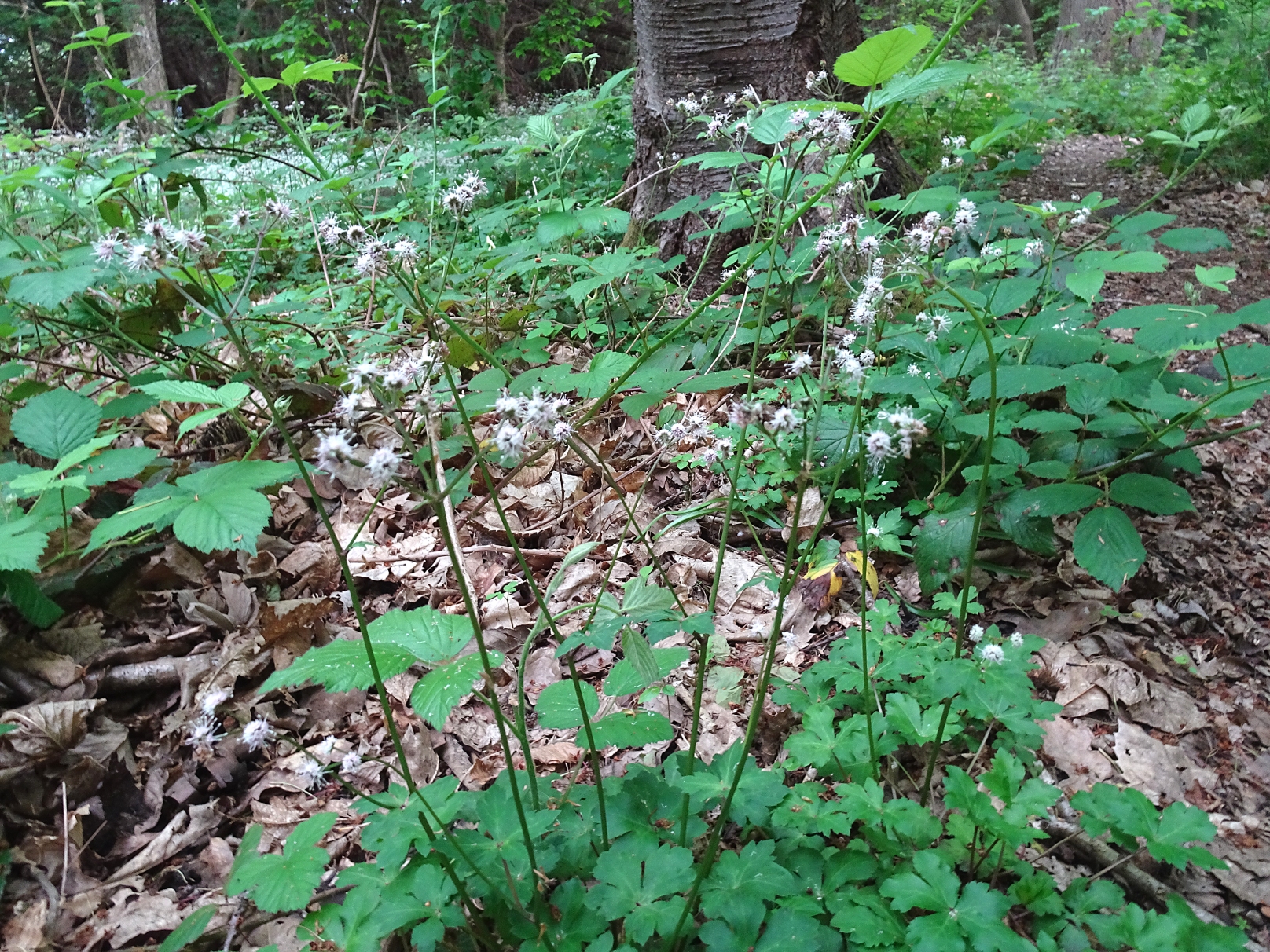
Sanicle...

Not all of the blizzard of white flowers in Mays Wood is down to the wild garlic. More than a casual glance will show that there is a large patch of woodruff lying on the left of the main path as you head westwards...

Woodruff, close-up...

Woodruff...